Get ready for the next version of Energinet
We're adding faster reporting, stronger security, and AI capabilities, and a scalable architecture built with data quality and stability in mind.
Kiona is renewing the platform behind Energinet, the EMS running in 45,000+ buildings and 145,000+ meters. This is not a new product. It is the same Energinet your customers rely on, rebuilt to meet tomorrow's tenders without switching EMS, delivered on a high-performance platform with a clear upgrade path for your current projects.
First release: December 2026. Today's Energinet continues with full support until all customers are migrated.
Why this matters now
If you are using Energinet today, you can keep going with confidence. If you are considering Energinet, you do not need to wait. You can start on today's system and move to the next generation when it launches, with no extra platform fee for that platform upgrade (per agreement). Implementation and custom work are quoted separately.
Want to stay close to the roadmap?
Receive updates, prototype invitations, pilot information, and practical guidance on what is coming next.

What stays the same
We are renewing the platform, not replacing the product. The essentials do not change:

Still Energinet for energy, waste and environmental reporting.

ISO 50001 and sustainability reporting remain central.

Works inside Kiona's platform: Web Port, IWMAC and Edge.

Full support for today's Energinet continues until each customer migrates.

Customers keep working with their existing Kiona contact or implementation partner.
What is new in the first release?
The first release focuses on key improvements.
AI-for electricity
The next generation includes an AI Assistant focused on electricity. It helps users spot trends, anomalies, and what to look at first. More energy types, including gas, heat, and water, are planned on the roadmap.
Stronger reporting
Process data in seconds and use categories, tags, and flexible selection across buildings, meters, and portfolios. This gives you more freedom than rigid tree structures and supports benchmarking, target tracking, and regulatory and sustainability reporting.
Modern interface
A completely new interface gives you clearer navigation and fewer clicks to insight. It is easier for new users to learn while helping experienced users work faster.
Open integrations
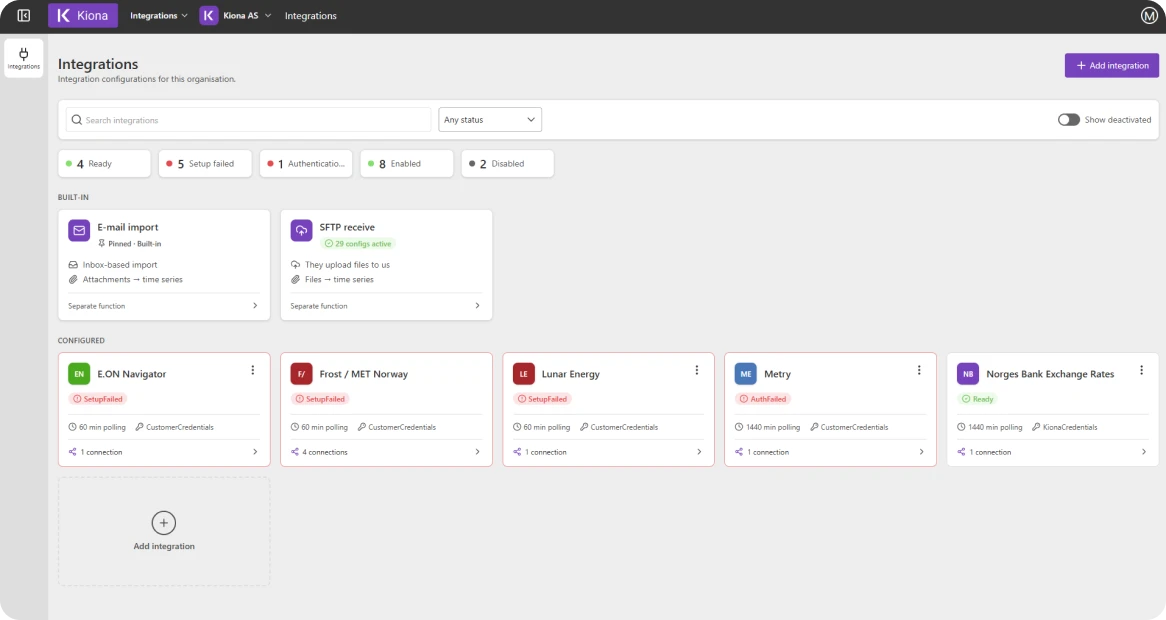
Modern integration patterns support building systems and third-party software, so Energinet can connect to what you already run.
Portfolio-level analysis
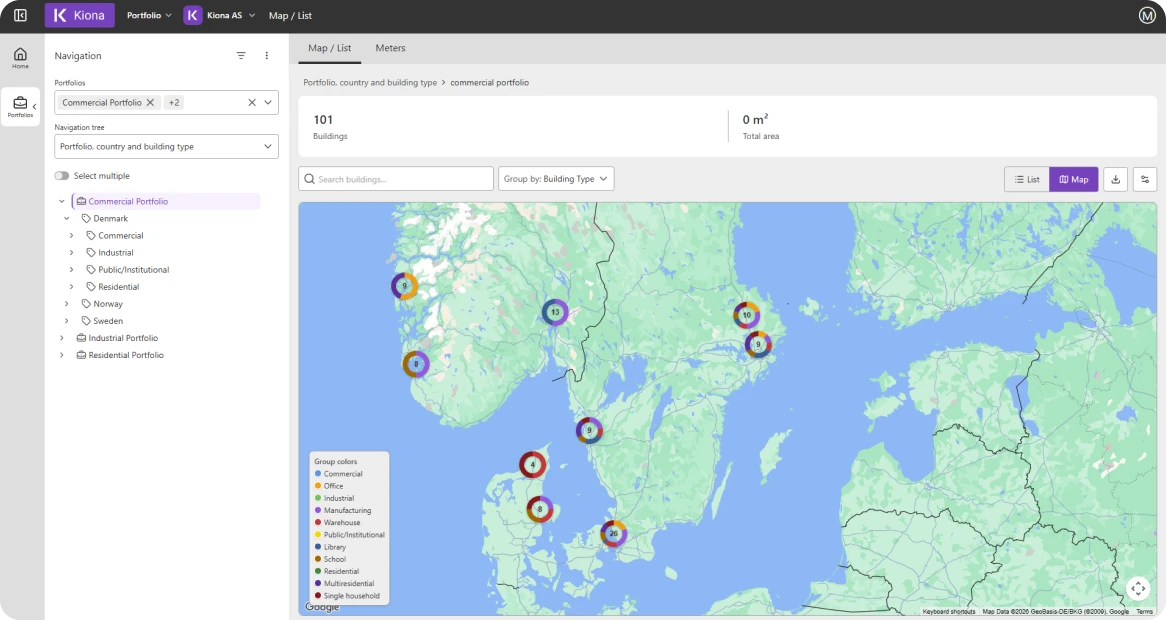
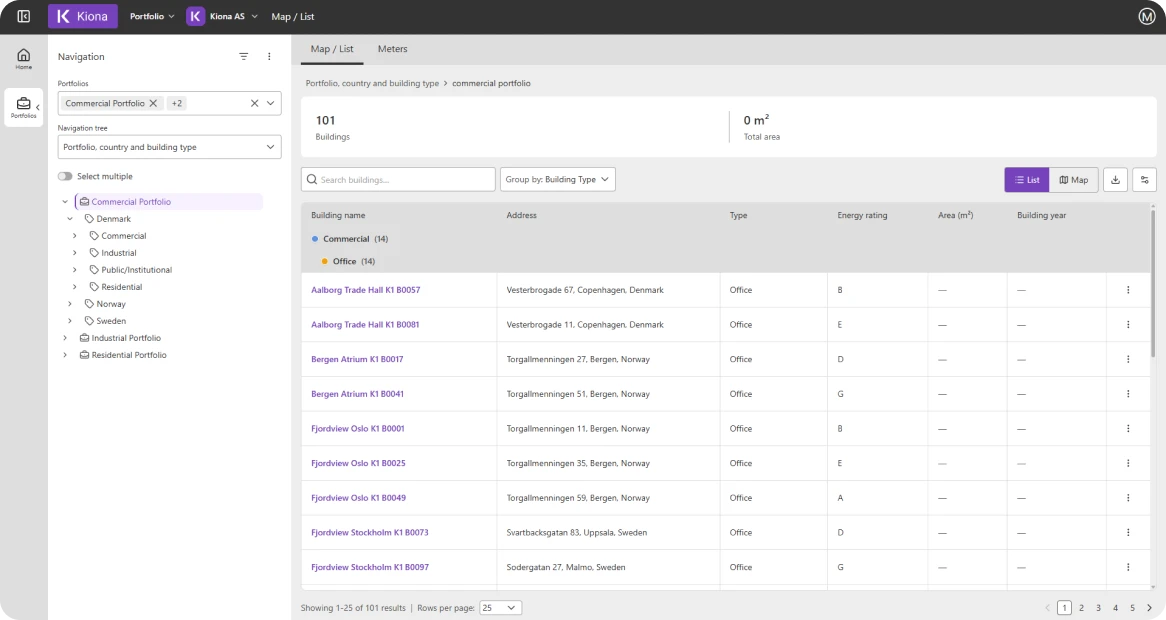
Analysis across buildings and meters is a first-class use case. Interactive map and list views, portfolio multiselect, search, and self-service classification.
Speed and security by design
Rapid data import and visualisation, on a cloud-native foundation. Stronger access control from day one.
First release scope at a glance
Here is what we are building for the first release, and where it is heading next. Use this with prospects so nobody is surprised at launch.
| Capability | Description | First release | Roadmap |
|---|---|---|---|
| AI for electricity | Flags trends and anomalies in electricity consumption and points the energy manager to the right building first – in plain language, not just graphs. Electricity only at first release. | Yes | Expanded prioritisation; water next, then district heating |
| Modern interface and navigation | A new interface with clearer navigation and fewer clicks to insight. Dashboards, reports, graphs, and tables share one visual language. Faster for experienced users, quicker to learn for new ones. | Yes | |
| Portfolio-level analysis | Browse and filter buildings across portfolios using an interactive map or a sortable building table. Group by portfolio, classification, or location. Export any view to CSV or Excel. | Yes | More analysis templates |
| Reporting and sustainability reporting | Build reports using categories, labels, and flexible selection across buildings, meters, and portfolios. ISO 50001 and sustainability reporting are included. | Yes | |
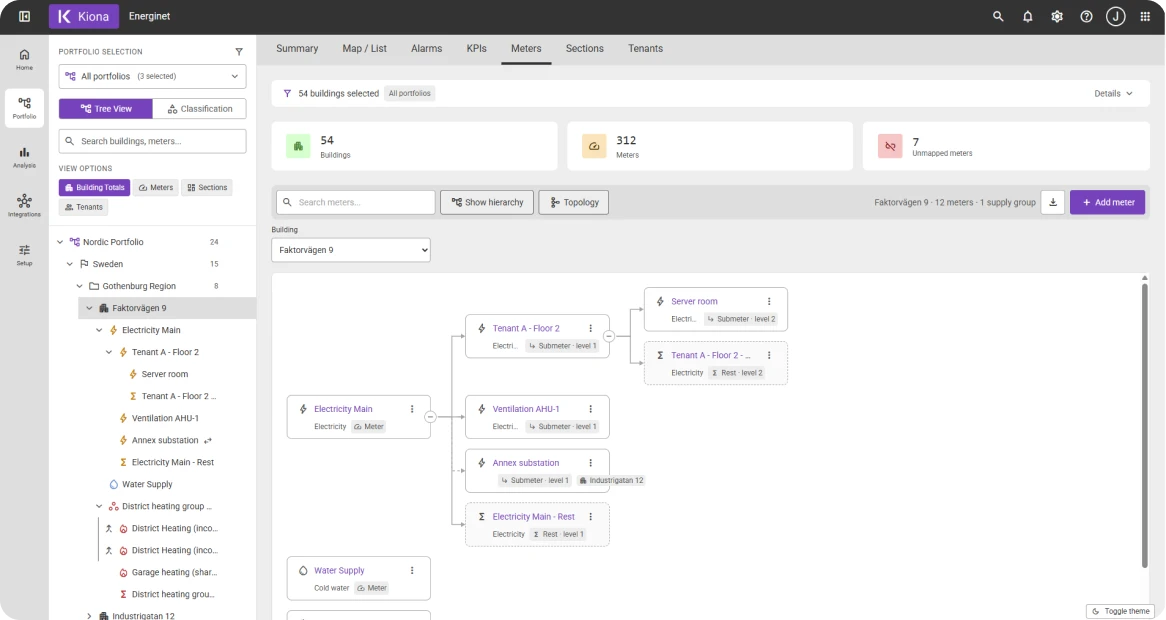
| Building and meter self-service | Create and edit buildings and meters from the list, map, or tree. Bulk-update fields across many buildings at once. Build sub-meter hierarchies, group meters into supply groups, and split buildings into sections and labels. | Yes | Bulk creation and CSV import; user-defined virtual meters |
| Data ingestion and integrations | Bring data in via API, SFTP, e-mail, and Elhub – all managed from one page. Each integration shows its status and sync history. Add new connections through guided setup and test before activating. Elhub users in Norway can add and activate metering points themselves. | Yes | More national data hubs |
| Custom configurations and migration | Today's Energinet stays live with full support alongside the new platform. Migration runs in phases through 2027, with notice and a guide before each customer moves. Custom setups are assessed individually – flag heavy customisations early. | Reviewed per customer during migration |

AI? Of course.
Built on what works – prepared for what is next.
Today's Energinet is a proven, mature product for energy, waste, and environmental reporting. The next generation builds on this foundation, moving to a cloud-native, AI-ready platform.
You can look forward to a minimal wait between data import and visualisation, removing the need for manual configuration in complex setups. Reporting is also getting and upgrade with categories, tags, flexible sections, and next-generation dashboards. The new platform will include AI for electricity from the first release, with more to follow.


Security and compliance
Tenders ask for stronger data security. The renewed platform is built on:
- Strong identity and access control with multi-factor authentication (MFA).
- Delegated administration for customers and partners.
- Zero-trust architecture principles.
- Secure defaults across the platform.
- Compliance posture aligned with current and upcoming regulations.

How migration works

Migration will be phased through 2026–2027. It will not happen overnight.
- Full support continues on today's version of Energinet until each customer migrates.
- Advance notice means no customer moves without knowing first.
- A pilot-validated approach means the migration process is tested before a broader rollout.
- The published migration guide will be available before customer moves begin.
- Custom setups are documented per customer, so we are transparent about what transfers and what needs testing.
No action is required today. We will share guidance in advance and support each step of the process.
Support for customers and partners

Guidance and materials
We will share up-to-date materials, practical information, and clear messaging to support conversations, planning and decision making.
Training
Training modules and webinars will be available through Q4 2026, with more details shared as the plan is confirmed.
Pilot involvement
Selected participants will be invited to join pilots in Q3 2026. This gives early hands-on access, direct feedback channels, and a closer view of migration planning.
Ongoing support
Support will continue throughout the rollout, with clear contact points for commercial, product, and technical questions.
What to expect in 2026
| Timeline | What you can expect |
| Q2 | First mock-ups of key views and flows · Initial feedback workshop with selected partners · Start of regular update cadence. |
| Q3 | Updated mock-ups and early clickable prototype · Partner feedback sessions (UX and workflow focus). |
| End of Q3 | Live demo of an early version (non-production) · Invitation for selected partners to register interest for early access and pilots · First look at high-level migration principles |
| Q4 | Training sessions and webinars for partner teams · Clear pilot and onboarding plan for first shared customers. |
| End of 2026 | First release of the next generation Energinet. |
| 2026-2027 | Phased customer migration with advance notice. |
Stay informed on what comes next
We'll keep existing partners and customers informed about progress with regular e-mail updates.
If you have questions about an active opportunity, contact your usual Kiona contact or partner manager. For product and technical questions, reach out to the partner team directly.

Sign up for partner early access
FAQ

No. You can start on today’s Energinet now and move to the next generation when it launches, with no extra platform fee for that platform upgrade (per agreement).
No extra platform fee applies for the upgrade. Implementation and custom work are quoted separately.
No. It is the same product on a renewed platform.
No. Full support continues. Migration is phased, with advance notice and a published guide before each move.
It supports electricity analysis by highlighting trends, anomalies, and priorities. More energy types are planned later.
Every setup is different. We document which transfers apply to each customer and validate them during pilots. If you have heavy customisations, flag them early so they can be assessed.
Yes. It works within the same Kiona Platform.
Yes. They remain central to the product.